
These are my personal views, produced in the odd pockets of time during the weekend when no one was asking me for a document or a deck. Written with my own resources. Represents no employer.
Psychologists have conducted some truly disturbing experiments on gifting.
In one study, researchers handed people money and asked them to buy a gift for themselves and a gift for a stranger. People consistently bought worse gifts for others than they did for themselves. Cheaper, more generic, less thoughtful — even when the money wasn’t theirs!
In another experiment, recipients liked their gift less when told it was expensive. Apparently, nothing breeds suspicion like generosity.
And in the most damning study of all, people giving gift cards thought they were being “flexible” and “considerate,” while the recipients quietly felt it meant: “You didn’t even try.”
The conclusion across all the research is universal and depressing: humans are terrible at gifting because gifting requires attention, not money — and attention is a scarce human resource.
The Shock of Modern Gifting
After moving to the US, the biggest cultural shock wasn’t the taxes or the weather — it was the industrial scale of gifting.
Kids are groomed early to expect gifts… the way adults expect promotions. I’ve assembled more “goodie bags” for my three-year-old’s daycare than PRDs in some past quarters.
When I deny my daughter something, she retaliates with her signature line:
“No goodie bags for you!” Delivered with the calm authority of a tiny mob boss. Something she’s clearly absorbed at daycare, where gift economics is taught earlier than phonics.
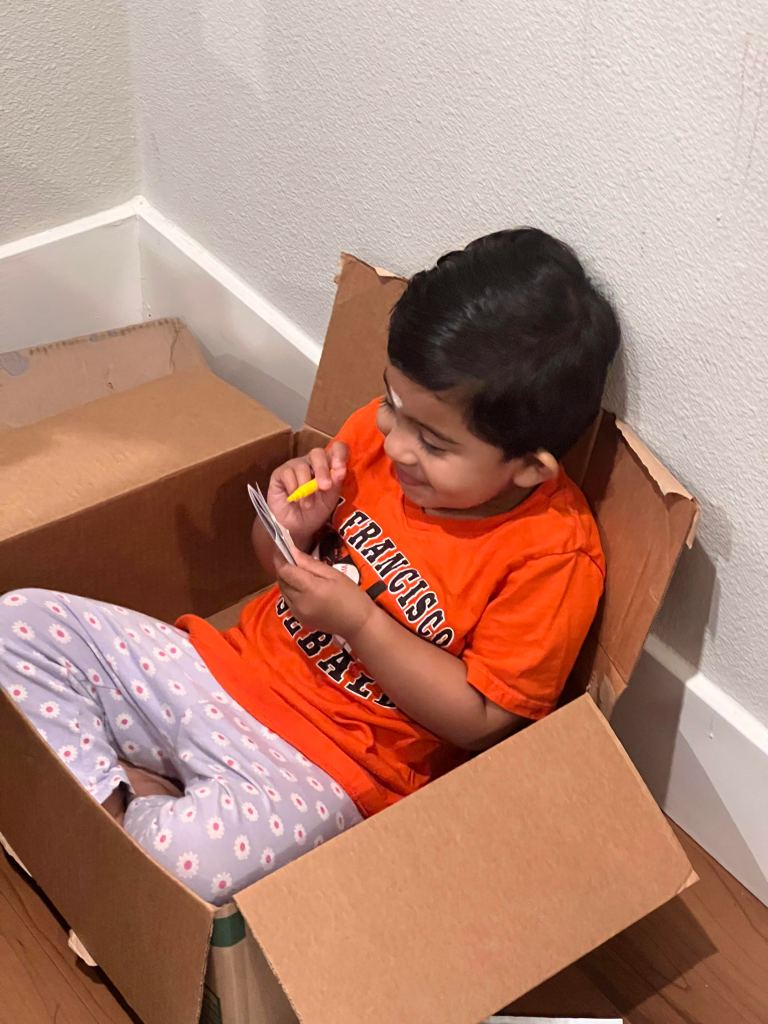
Photo Courtesy: Me featuring the tiny mob boss
It was then I realised: gifting today isn’t affection.
Most gifts today are simply objects wandering in search of a meaning. But once in a while, you meet a human who gives a gift that genuinely shocks you — not because of its price, but because it proves something you had almost forgotten:
People paying attention exist.
This holiday post is about a few such people I’ve known — people who noticed with embarrassing accuracy. And because they noticed, they turned out to be remarkable gifters.
Shankar & The Chair for Bezos
The first time I realized that noticing is a rare human skill was when I watched Shankar Ganesh operate as a PM at Freshworks.
If I admired one PM in my first job, it was him — not for speaking the loudest or looking busiest, but for that inconvenient talent of actually understanding things and finding the simplest ways to delight customers.
He was behind several thoughtful product and marketing decisions that delighted tens of thousands of Freshworks customers — the sort of work most PMs would immediately convert into a 17-tweet or LinkedIn dissertation about “customer obsession,” but to me, it seemed like Shankar treated it like play.
Many years later, I learned he had done something that was unmistakably Shankar — simple, sharp, and quietly brilliant. Our CEO, Girish Mathrubootham (or G as we fondly called him) was preparing to meet Jeff Bezos. At that point, Freshworks was an AWS customer and our cloud bills could fund a modest nation-state or, at minimum, one of Jeff’s yacht.
So G began hunting for gift ideas.
What can one possibly buy as a gift for Bezos – the man who has everything?
Shankar, characteristically, treated it like a design problem:
- It should feel like you’ve read the other person’s mind. That’s where the surprise and happiness come from
- It can have utilitarian value, but that is optional. Usefulness is not the point
- It must be memorable. If it disappears into the background of their life, it has failed
This is why he disliked water bottles and notebooks as gifts. They tick the “useful” box, but they are neither thoughtful nor memorable.
Shankar had read a Forbes article on how Amazon decodes customers, which reminded him of Bezos’s famous empty chair in the WBR meetings representing the customer — the only person in the room who could not be fired. That chair was Bezos’s religion.
Shankar suggested gifting a miniature version of that chair. He disappeared for a day, reappeared during Navratri after searching through Mylapore and then Perungudi, where he finally found model makers who could deliver in two days. He handed them reference photos and a line he wanted on the note:
“For all the decisions you make.”
Later, in classic Shankar fashion, he said he should have written:
“From one company that cares about its customers to another.”
Even his regrets had better copy than most corporate campaigns.
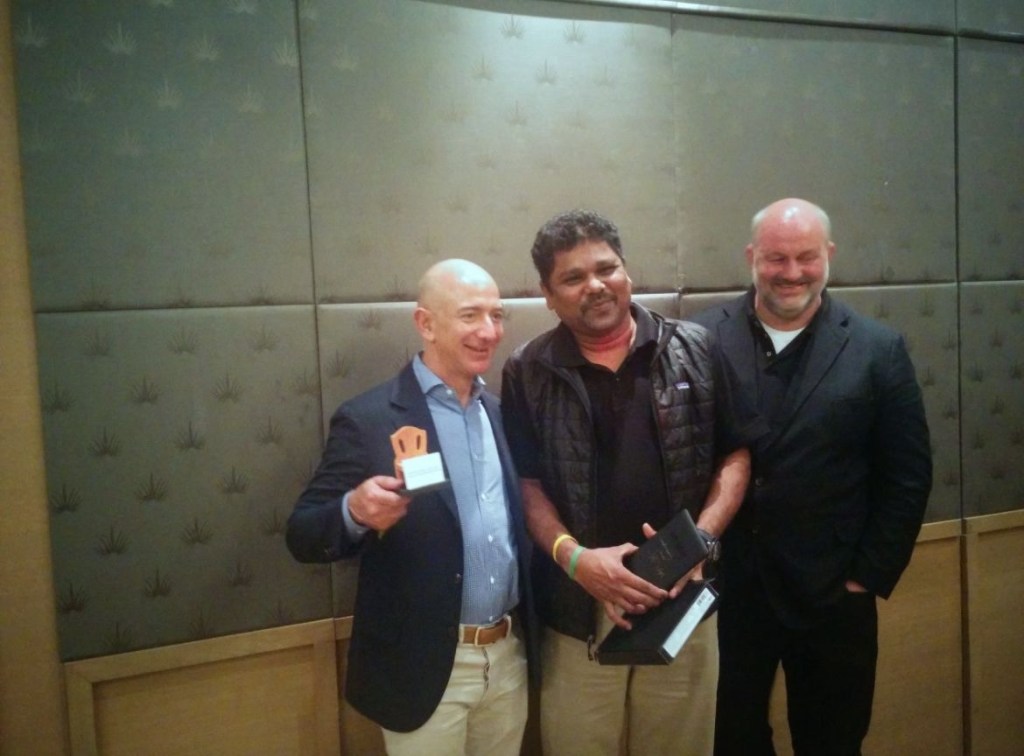
Picture courtesy: Shankar
Bezos loved the chair. Not because it was grand, but because it was precise. It held up a mirror to the version of himself he liked the most – the man who left an empty chair for the customer.
Prasannan & This Blog
Prasannan was one of the earliest Android developers at Freshworks and pretty damn good at his work, the kind of engineer who just got things done. He was also the unfortunate colleague who tolerated my early product ideas, which I pitched with the confidence of a TED speaker.
Prasannan gifted me vandana.guru with the 1-year SSL certificate!
I didn’t know “.guru” TLD existed.
I didn’t know my name was available.
And I certainly didn’t expect a developer to notice it before I even realised I wanted it.
But Prasannan did what people who pay attention naturally do — he spotted something about me that I hadn’t admitted to myself: that I was in Marketing, I wrote on Medium and Twitter and wanted to build something of my own, long before I had the courage to say so.
The domain forced me to learn a bit of HTML.
It forced me to understand hosting. (I tried S3 and AWS and landed a pretty hefty bill, a separate story)
It forced me to stay curious.
It forced me, essentially, to stop orbiting software and enter it when most folks from my university had left the company after year 1 and I was starting to get insecure.
I doubt any future gift will compete with this one, unless someone hands me absolute clarity about my life.
Leader & The Gift of Feedback
If there is someone I quietly aspire to be someday sans the title, it is this VP — someone with an unnatural ability to notice details everyone else treats as background noise.
He reviewed Figma files the way a jeweller inspects diamonds. It was unnerving. People at his level are supposed to speak in abstractions; he zoomed into pixels.
Over time, I built a mental model of him in my head — anticipating what he would question, where he would pause, and which part of the design he would see through immediately. And without meaning to, he sharpened my own taste.
What I eventually understood was that his “tactical feedback” wasn’t tactical at all. It was a belief. You don’t pay that level of attention to someone you’ve written off. Precision is its own form of generosity.
Most gift praise. A few gift advice. He gifted standards — the rarest gift of all
Related post
Final one’s Anti-climax: My Amma and Our Gift-of-the-Magi moment
My Amma expressed love through practicality mainly by buying me endless bottles of Ayurvedic oils to maintain my four‑foot‑long hair. In her mind, that hair was not just hair; it was identity, discipline, and maternal pride.
Then one day, I cut it short. Efficiency-short.

Picture courtesy: My brother, Pranav
She looked at me like I’d erased a family asset. The oils still arrived for a while, mostly out of habit and heartbreak.
In her recent visit to the US, I gifted her a Michael Kors handbag something she had been dreaming of. She was delighted — until the honest-PM in me explained that Michael Kors was “affordable luxury,” not “real luxury.”
Her joy disappeared instantly.
It was our Gift of the Magi moment: She kept giving me oils for hair I no longer had, and I destroyed the joy in the gift I chose for her.
And it taught me a simple truth:
A good gift is accurate — but not so accurate that it ruins the meaning the other person has assigned to it.
Across all these gifters, the pattern is clear: The best gifts were never grand. They were precise and creative.
Someone saw something about the other person — an aspiration, a limitation, a blind spot — before the other person saw it themselves.
And that is the uncomfortable truth at the heart of both gifting and product work:
You cannot build well for someone you have not learned to notice.
It is the difference between hearing a request and understanding the need.
And in a world that optimises for speed, templates, and “best practices,” this kind of attention is becoming rare enough that sometimes it starts to feel like affection.
So if there is one transferable idea from all these stories — one lesson for anyone who builds products, teams, or anything that hopes to matter — it is this:
The real work is learning to notice. Rest is executing on that.
 Observation Book
2 responses to “The Power of Noticing: Lessons from Great Gifters”
Hi Vandana, I really enjoyed reading this one. 🩷 Lots to learn from the power of noticing. Just last week I was asking my friend as to how or why I was not a good gift giver! This landed in my inbox at the right time, taught me a bit, and made me revisit that conversation. Thanks for writing about it 🙂
Mit freundlichen Grüßen, Swathi Sriram
LikeLike
Thank you Swathi! 🙂
LikeLike